The Rock, and The Hard Place
Looking into the near-term future—say, between now and 2020—we in higher education have to address two big challenges, both involving IT. Neither admits easy progress. But if we don’t address them, we’ll find ourselves caught between a rock and a hard place.
- The first challenge, the rock, is to deliver high-quality, effective e-learning and curriculum at scale. We know how to do part of that, but key pieces are missing, and it’s not clear how will find them.
- The second challenge, the hard place, is to recognize that enterprise cloud services and personal devices will make campus-based IT operations the last rather than the first resort. This means everything about our IT base, from infrastructure through support, will be changing just as we need to rely on it.
“But wait,” I can hear my generation of IT leaders (and maybe the next) say, “aren’t we already meeting those challenges?”
If we compare today’s e-learning and enterprise IT with that of the recent past, those leaders might rightly suggest, immense change is evident:
- Learning management systems, electronic reserves, video jukeboxes, collaboration environments, streamed and recorded video lectures, online tutors—none were common even in 2000, and they’re commonplace today.
- Commercial administrative systems, virtualized servers, corporate-style email, web front ends—ditto.
That’s progress and achievement we all recognize, applaud, and celebrate. But that progress and achievement overcame past challenges. We can’t rest on our laurels.
We’re not yet meeting the two broad future challenges, I believe, because in each case fundamental and hard-to-predict change lies ahead. The progress we’ve made so far, however progressive and effective, won’t steer us between the rock of e-learning and the hard place of enterprise IT.
The fundamental change that lies ahead for e-learning
is the the transition from campus-based to distance education
 Back in the 1990s, Cliff Adelman, then at the US Department of Education, did a pioneering study of student “swirl,” that is, students moving through several institutions, perhaps with work intervals along the way,before earning degrees.
“The proportion of undergraduate students attending more than one institution,” he wrote, “swelled from 40 percent to 54 percent … during the 1970s and 1980s, with even more dramatic increases in the proportion of students attending more than two institutions.” Adelman predicted that “…we will easily surpass a 60 percent multi-institutional attendance rate by the year 2000.”
Moving from campus to campus for classes is one step; taking classes at home is the next. And so distance education, long constrained by the slow pace and awkward pedagogy of correspondence courses, has come into its own. At first it was relegated to “nontraditional” or “experimental” institutions—Empire State College, Western Governors University, UNext/Cardean (a cautionary tale for another day), Kaplan. Then it went mainstream.
 At first this didn’t work: fathom.com, for example, a collaboration among several first-tier research universities led by Columbia, found no market for its high-quality online offerings. (Its Executive Director has just written a thoughtful essay on MOOCs, drawing on her fathom.com experience.)
Today, though, a great many traditional colleges and universities successfully bring instruction and degree programs to distant students. Within the recent past these traditional institutions have expanded into non-degree efforts like OpenCourseWare and to broadcast efforts like the MOOC-based Coursera and edX. In 2008, 3.7% of students took all their coursework through distance education, and 20.4% took at least one class that way.
Learning management systems, electronic reserves, video jukeboxes, collaboration environments, streamed and recorded video lectures, online tutors, the innovations that helped us overcome past challenges—little of that progress was designed for swirling students who do not set foot on campus.
We know how to deliver effective instruction to motivated students at a distance. Among policy issues we have yet to resolve, we don’t yet know how to
- confirm their identity,
- assess their readiness,
- guide their progress,
- measure their achievement,
- standardize course content,
- construct and validate curriculum across diverse campuses, or
- certify degree attainment
in this imminent world. Those aren’t just IT problems, of course. But solving them will almost certainly challenge IT.
The fundamental change that lies ahead for enterprise technologies
is the transition from campus IT to cloud and personal IT
The locus of control over all three principal elements of campus IT—servers and services, networks, and end-user devices and applications—is shifting rapidly from the institution to customers and third parties.
 As recently as ten years ago, most campus IT services, everything from administrative systems through messaging and telephone systems to research technologies, were provided by campus entities using campus-based facilities, sometimes centralized and sometimes not. The same was true for the wired and then wireless networks that provided access to services, and for the desktop and laptop computers faculty, students, and staff used.
Today shared services are migrating rapidly to servers and systems that reside physically and organizationally elsewhere—the “cloud”—and the same is happening for dedicated services such as research computing. It’s also happening for networks, as carrier-provided cellular technologies compete with campus-provided wired and WiFi networking, and for end-user devices, as highly mobile personal tablets and phones supplant desktop and laptop computers.
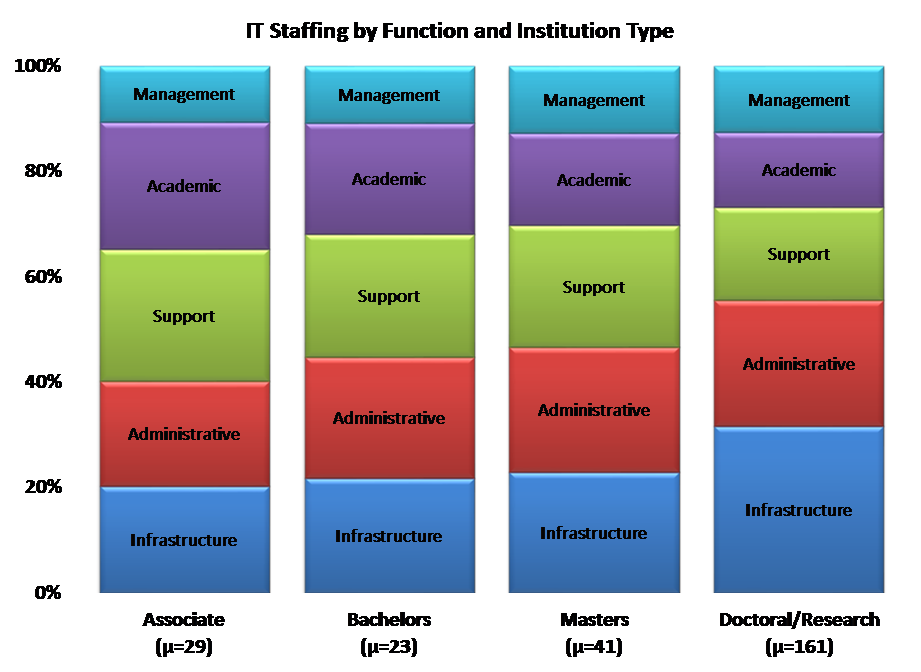 As I wrote in an earlier post about “Enterprise IT,” the scale of enterprise infrastructure and services within IT and the shift in their locus of control have major implications for and the organizations that have provided it. Campus IT organizations grew up around locally-designed services running on campus-owned equipment managed by internal staff. Organization, staffing, and even funding models ensued accordingly. Even in academic computing and user support, “heavy metal” experience was valued highly. The shifting locus of control makes other skills at least as valuable: the ability to negotiate with suppliers, to engage effectively with customers (indeed, to think of them as “customers” rather than “users”), to manage spending and investments under constraint, to explain.
To be sure, IT organizations still require highly skilled technical staff, for example to fine-tune high-performance computing and networking, to ensure that information is kept secure, to integrate systems efficiently, and to identify and authenticate individuals remotely. But these technologies differ greatly from traditional heavy metal, and so must enterprise IT.
The rock, IT, and the hard place
In the long run, it seems to me that the campus IT organization must evolve rapidly to center on seven core activities.
Two of those are substantive:
- making sure that researchers have the technologies they need, and
- making sure that teaching and learning benefit from the best thinking about IT applications and effectiveness.
Four others are more general:
- negotiating and overseeing relationships with outside providers;
- specifying or doing what is necessary for robust integration among outside and internal services;
- striking the right personal/institutional balance between security and privacy for networks, systems, and data; and last but not least
- providing support to customers (both individuals and partner entities).
The seventh core activity, which should diminish over time, is
- operating and supporting legacy systems.
Creative, energetic, competent staff are sine qua non for achieving that kind of forward-looking organization. It’s very hard to do good IT without good, dedicated people, and those are increasingly difficult to find and keep. Not least, this is because colleges and universities compete poorly with the stock options, pay, glitz, and technology the private sector can offer. Therein lies another challenge: promoting loyalty and high morale among staff who know they could be making more elsewhere.
 To the extent the rock of e-learning and the hard place of enterprise IT frame our future, we not only need to rethink our organizations and what they do; we also need to rethink how we prepare, promote, and choose leaders for higher-education leaders on campus and elsewhere—the topic, fortuitously, of a recent ECAR report, and of widespread rethinking within EDUCAUSE.
We’ve been through this before, and risen to the challenge.
- Starting around 1980, minicomputers and then personal computers brought IT out of the data center and into every corner of higher education, changing data center, IT organization, and campus in ways we could not even imagine.
- Then in the 1990s campus, regional, and national networks connected everything, with similarly widespread consequences.
We can rise to the challenges again, too, but only if we understand their timing and the transformative implications.
 Old joke. Someone writes a computer program (creates an app?) that translates from English into Russian (say) and vice versa. Works fine on simple stuff, so the next test is a a bit harder: “the spirit is willing, but the flesh is weak.” The program/app translates the phrase into Russian, then the tester takes the result, feeds it back into the program/app, and translates it back into English. Result: “The ghost is ready, but the meat is raw.”
 About a decade ago, several of us were at an Internet2 meeting. A senior Microsoft manager spoke about relations with higher education (although looking back, I can’t see why Microsoft would present at I2. Maybe it wasn’t an I2 meeting, but let’s just say it was — never let truth get in the way of a good story). At the time, instead of buying a copy of Office for each computer, as Microsoft licenses required, many students, staff, and faculty simply installed Microsoft Office on multiple machines from one purchased copy — or even copied the installation disks and passed them around. That may save money, but it’s copyright infringement, and illegal.
 But at least one campus, which I’ll call Pi University, balked. The Campus Agreement, PiU’s golf-loving CIO pointed out, had a provision no one had read carefully: if PiU withdrew from the Campus Agreement, he said, it might be required to list and pay for all the software copies that PiU or its students, faculty, and staff had acquired under the Campus Agreement — that is, to buy what it had been renting. The PiU CIO said that he had no way to comply with such a provision, and that therefore PiU could not in good faith sign an agreement that included it.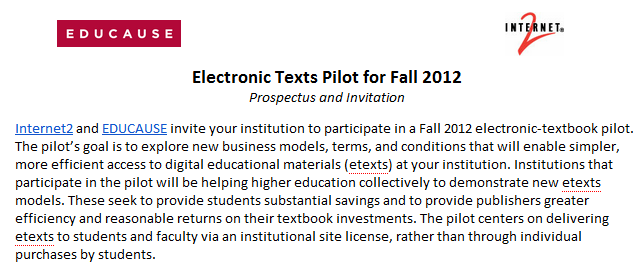
 According to the
  Over the past few years this changed, first gradually and then more abruptly.
 The CIO from one campus — I’ll call it Omega University — discovered that a recent renewal of the bookstore contract provided that during the 15-year term of the contract, “the Bookstore shall be the University’s …exclusive seller of all required, recommended or suggested course materials, course packs and tools, as well as materials published or distributed electronically, or sold over the Internet.” The OmegaU CIO was outraged: “In my mind,” he wrote, “the terms exclusive and over the Internet can’t even be in the same sentence! And to restrict faculty use of technology for next 15 years is just insane.”


 Today, for example, the rapidly growing capability of small smartphones has taxed previously underused cellular networks. Earlier, excess capability in the wired Internet prompted innovation in major services like
  Progress, convergence, and integration in information technology have driven dramatic and fundamental change in the information technologies faculty, students, colleges, and universities have. That progress is likely to continue.
 Everyone – or at least everyone between the ages of, say, 12 and 65 – has at least one authenticated online
  It’s striking how many of these assumptions were invalid even as recently as five years ago. Most of the assumptions were invalid a decade before that (and it’s sobering to remember that the “3M” workstation was a lofty goal as recently as 1980 and cost nearly $10,000 in the mid-1980s, yet today’s
  In colleges and universities, as in other organizations, information technology can promote progress by enabling administrative processes to become more efficient and by creating diverse, flexible pathways for communication and collaboration within and across different entities. That’s organizational technology, and although it’s very important, it affects higher education much the way it affects other organizations of comparable size.
 For example, by storing and distributing materials electronically, by enabling lectures and other events to be streamed or recorded, and by providing a medium for one-to-one or collective interactions among faculty and students, IT potentially expedites and extends traditional roles and transactions. Similarly, search engines and network-accessible library and reference materials vastly increase faculty and students access. The effect, although profound, nevertheless falls short of transformational. Chairs outside faculty doors give way to “learning management systems” like
  For example, the
  This most productively involves experience that otherwise might have been unaffordable, dangerous, or otherwise infeasible. Simulated chemistry laboratories and factories were an early example – students could learn to
  This is the most controversial application of learning technology – “Why do we need faculty to teach calculus on thousands of different campuses, when it can be taught online by a computer?” – but also one that drives most discussion of how technology might transform higher education. It has emerged especially for disciplines and topics where instructors convey what they know to students through classroom lectures, readings, and tutorials. PLATO (Programmed Logic for Automated Teaching Operations) emerged from the
  The fundamental purpose of higher education is to advance society, polity, and the economy by increasing the social, political, and economic skills and knowledge of students – what economists call “
 Sometimes a student gets all four together. For example, MIT marked me even before I enrolled as someone likely to play a role in technology (admission), taught me a great deal about science and engineering generally, electrical engineering in particular, and their social and economic context (instruction), documented through grades based on exams, lab work, and classroom participation that I had mastered (or failed to master) what I’d been taught (certification), and immersed me in an environment wherein data-based argument and rhetoric guided and advanced organizational life, and thereby helped me understand how to work effectively within organizations, groups, and society (socialization).
 Instruction is an especially fertile domain for technological progress. This is because three trends converge around it:
 One problem with such a future is that socialization, a key function of higher education, gets lost. This points the way to one major technology challenge for the future: Developing online mechanisms, for students who are scattered across the nation or the world, that provide something akin to rich classroom and campus interaction. Such interaction is central to the success of, for example, elite liberal-arts colleges and major residential universities. Many advocates of distance education believe that social media such as Facebook groups can provide this socialization, but that potential has yet to be realized.
 Drivers headed for








 “There are two possible solutions,” Hercule Poirot says to the assembled suspects in Murder on the Orient Express (that’s p. 304 in
  The straightforward projection, analogous to Poirot’s simpler solution (an unknown stranger committed the crime, and escaped undetected), stems from projections how institutions themselves might address each of the IT domains as new services and devices become available, especially cloud-based services and consumer-based end-user devices. The core assumptions are that the important loci of decisions are intra-institutional, and that institutions make their own choices to maximize local benefit (or, in the economic terms I mentioned in
  One clear consequence of such straightforward evolution is a continuing need for central guidance and management across essentially the current array of IT domains. As I tried to suggest in
  If we think about the future unconventionally (as Poirot does in his second solution — spoiler in the last section below!), a somewhat more radical, extra-institutional projection emerges. What if Accenture, McKinsey, and Bain are right, and IT contributes very little to the distinctiveness of institutions — in which case colleges and universities have no business doing IT idiosyncratically or even individually?
 Despite changes in technology and economics, and some organizational evolution, higher education remains largely hierarchical. Vertically-organized colleges and universities grant degrees based on curricula largely determined internally, curricula largely comprise courses offered by the institution, institutions hire their own faculty to teach their own courses, and students enroll as degree candidates in a particular institution to take the courses that institution offers and thereby earn degrees. As
  The first challenge, which is already being widely addressed in colleges, universities, and other entities, is distance education: how to deliver instruction and promote learning effectively at a distance. Some efforts to address this challenge involve extrapolating from current models (many community colleges, “laptop colleges”, and for-profit institutions are examples of this), some involve recycling existing materials (Open CourseWare, and to a large extent the Khan Academy), and some involve experimenting with radically different approaches such as game-based simulation. There has already been considerable success with effective distance education, and more seems likely in the near future.
 As courses relate to curricula without depending on a particular institution, it becomes possible to imagine divorcing the offering of courses from the awarding of degrees. In this radical, no-longer-vertical future, some institutions might simply sell instruction and other learning resources, while others might concentrate on admitting students to candidacy, vetting their choices of and progress through coursework offered by other institutions, and awarding degrees. (Of course, some might try to continue both instructing and certifying.) To manage all this, it will clearly be necessary to gather, hold, and appraise student records in some shared or central fashion.
 Poirot’s second solution to the Ratchett murder (everyone including the butler did it) requires astonishing and improbable synchronicity among a large number of widely dispersed individuals. That’s fine for a mystery novel, but rarely works out in real life.
 Back in 1977,
  Higher education traditionally has placed a high value on institutional individuality. Some years back a Harvard faculty colleague of mine,
  At the same time, it has failed to make the critical distinction between what
  The dilemma is this:
 The situation isn’t quite the same for several colleges that might negotiate together for a good deal from a vendor, mostly because no one will get anything for free. But a problem like the prisoner’s dilemma arises when one or more members of the group conclude that they can get a better deal from the vendor by themselves than what they think the group would obtain. If those members try to cut side deals, the incentive for the vendor to deal with the other members shrinks, especially if the defecting members’ deals consume a substantial fraction of the vendor’s price flexibility. The vendor prefers doing a couple of side deals to the overall deal so long as the side deals require less total discount than the group deal would. Members have every incentive to cut side deals, vendors prefer a small number of side deals to a blanket deal, and so unless all the colleges behave altruistically a joint deal is unlikely.
 And so the $64 question: What would break this cycle? The answer is simple: sharing information, and committing to joint action. If the prisoners could communicate before deciding whether to defect or cooperate, their rational choice would be to cooperate. If colleges shared information about their plans and their deals, the likelihood of effective joint action would increase sharply. That would be good for the colleges and not so good for the vendor. From this perspective, it’s clear why non-disclosure clauses are so common in vendor contracts.